India CPI Inflation Hits 17-Month High: Impact on RBI & Investors
India's Inflation Is Rising Again – Should Investors Be Concerned?
India’s retail inflation has climbed to its highest level in nearly one and a half years, signalling that price pressures are gradually spreading across the economy.
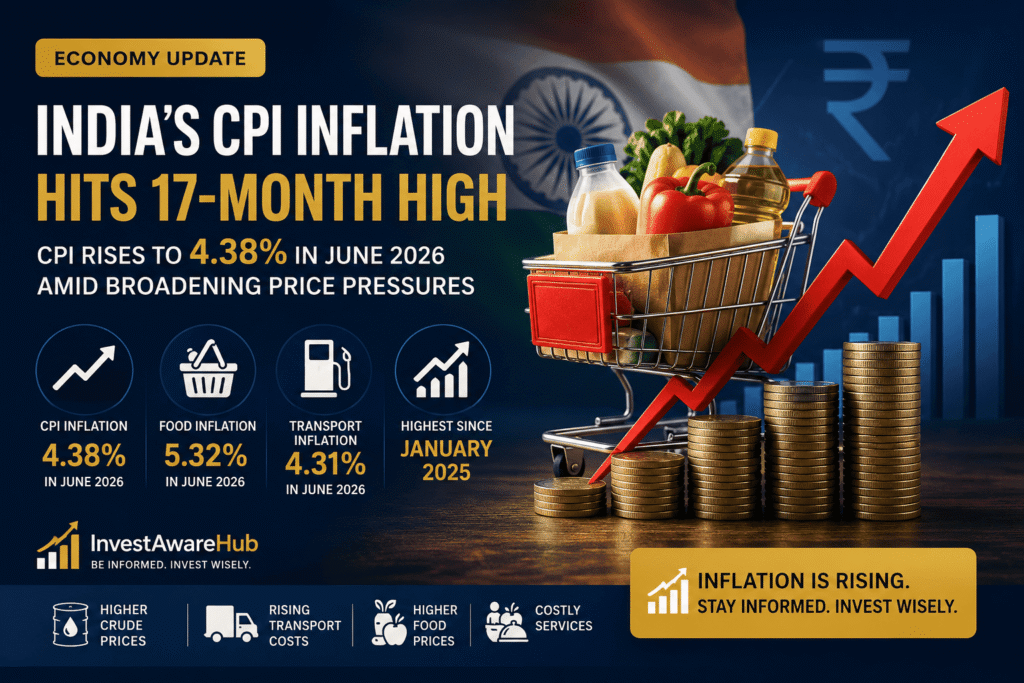
According to the latest Consumer Price Index (CPI) data, headline inflation increased to 4.38% year-on-year in June 2026, compared to 3.93% in May 2026. This marks a significant monthly rise and represents the highest inflation reading since January 2025.
While inflation remains within the Reserve Bank of India’s (RBI) tolerance band, the broad-based increase across food, transportation, education and services suggests that inflationary pressures are becoming more persistent.
For households, this could mean higher living costs.
For investors, it could influence interest rates, bond yields and equity market performance in the coming months.
Key Highlights of India's CPI Inflation (June 2026)
| Indicator | May 2026 | June 2026 |
|---|---|---|
| Headline CPI Inflation | 3.93% | 4.38% |
| Food Inflation | 4.78% | 5.32% |
| Increase in CPI | — | +45 basis points |
| Increase in Food Inflation | — | +54 basis points |
This is the strongest inflation reading in 17 months, indicating that price increases are no longer confined to a few categories but are becoming increasingly widespread.
What's Driving Inflation Higher?
Several factors contributed to June’s inflation surge.
1. Rising Transportation Costs
Transportation emerged as the biggest contributor to inflation.
Transport inflation jumped sharply from 1.75% to 4.31%, largely because of:
- Higher petrol and diesel prices
- Increased freight charges
- Rising passenger transport costs
- Elevated global crude oil prices
Geopolitical tensions in the Middle East pushed crude oil prices higher, and these increased fuel costs gradually filtered through the broader economy.
2. Food Prices Continue to Rise
Food inflation accelerated to 5.32%, driven by higher prices across essential food categories.
Food inflation is particularly important because it directly impacts household budgets and contributes significantly to India’s overall inflation basket.
Weather uncertainties and supply-side disruptions remain important risks for food prices.
3. Inflation Is Becoming Broad-Based
Inflation is no longer limited to fuel and food.
Several sectors witnessed noticeable price increases:
- Restaurants & Accommodation
- Food & Beverages
- Education
- Household Furnishings
- Personal Care & Miscellaneous Services
This suggests businesses are increasingly passing higher input costs on to consumers.
Middle East Tensions Continue to Influence Inflation
Since geopolitical tensions intensified in the Middle East during February 2026, India’s inflation has steadily moved upward.
Headline CPI increased from 3.21% in February 2026 to 4.38% in June 2026, reflecting a cumulative increase of 117 basis points.
The transmission occurred in phases:
- Higher crude oil prices
- Rising fuel costs
- Increased transportation expenses
- Higher logistics costs
- Costlier food distribution
- Increased service sector prices
This demonstrates how global geopolitical events can quickly affect domestic inflation in India.
What Does This Mean for RBI?
The Reserve Bank of India closely monitors inflation while determining monetary policy.
With inflation gradually moving toward the upper end of RBI’s comfort zone, policymakers may prefer a cautious approach.
Current expectations include:
- Maintaining existing policy rates in the near term
- Closely monitoring crude oil prices
- Watching food inflation during the monsoon season
- Evaluating global geopolitical developments
If inflation remains elevated for several months, the possibility of future monetary tightening cannot be ruled out.
Impact on Investors
Equity Investors
Moderately higher inflation does not necessarily hurt equity markets immediately.
However:
- Banking stocks may benefit if interest rates remain elevated.
- Consumer discretionary companies could face pressure due to weaker spending.
- FMCG companies may experience margin compression if input costs rise.
- Energy companies may benefit from stronger crude prices.
Debt Mutual Fund Investors
Higher inflation generally pushes bond yields upward.
As yields rise:
- Existing long-duration bonds may temporarily decline in value.
- Short-duration debt funds become relatively attractive.
- Investors should consider interest rate sensitivity before investing.
Fixed Deposit Investors
If inflation remains elevated and interest rates stay higher for longer:
- Banks may continue offering attractive FD rates.
- Real returns should always be evaluated after adjusting for inflation.
SIP Investors
Long-term investors should avoid reacting emotionally to short-term inflation data.
History shows that disciplined SIP investing has successfully navigated multiple inflation cycles.
Rather than timing the market, investors should:
- Continue regular SIPs
- Review asset allocation periodically
- Increase investments during market corrections where appropriate
Risks to Watch Going Forward
Several factors could keep inflation elevated:
Rising Crude Oil Prices
Further escalation in global conflicts could increase energy prices.
Weather Risks
An unfavourable monsoon or El Niño conditions may increase food inflation.
Supply Chain Disruptions
Higher transportation and logistics costs could spread inflation across multiple industries.
Global Economic Uncertainty
Currency fluctuations and imported inflation remain key risks for emerging economies like India.
What Should Investors Do?
Instead of reacting to every inflation announcement, investors should focus on long-term financial planning.
A balanced portfolio should include:
- Equity Mutual Funds
- Debt Investments
- Gold (where appropriate)
- Emergency Fund
- Adequate Insurance Coverage
Maintaining proper asset allocation remains the best defence against inflation and market uncertainty.
InvestAwareHub's View
The latest inflation data suggests that price pressures are gradually broadening beyond food and fuel.
While the current inflation level remains manageable, sustained increases could influence RBI policy decisions, bond yields and investor sentiment over the coming quarters.
Long-term investors should avoid making emotional investment decisions based on a single month’s inflation reading. Instead, focus on disciplined investing, diversification and periodic portfolio reviews.
Frequently Asked Questions (FAQs)
What is CPI Inflation?
Consumer Price Index (CPI) measures the average change in prices paid by consumers for goods and services over time. It is India’s primary measure of retail inflation.
Why has inflation increased in June 2026?
The increase was mainly driven by higher food prices, rising transportation costs and elevated crude oil prices caused by geopolitical tensions.
How does inflation affect mutual funds?
Higher inflation may increase market volatility and influence interest rates. Equity and debt mutual funds can be affected differently depending on the economic environment.
Can higher inflation lead to higher interest rates?
Yes. If inflation remains persistently high, central banks may increase interest rates to control price growth.
Should investors stop SIPs during inflation?
No. Long-term SIP investors generally benefit from remaining invested through different market cycles.
Conclusion
India’s June 2026 inflation data serves as an important reminder that global events can quickly influence domestic prices. While inflation has risen to a 17-month high, it remains within the RBI’s tolerance range. The coming months will be crucial as policymakers assess the impact of energy prices, food inflation and geopolitical developments.
For investors, the key takeaway is to remain disciplined, diversify investments and focus on long-term wealth creation rather than reacting to short-term economic fluctuations.
Disclaimer:
The information provided in this blog is for informational and educational purposes only and should not be construed as financial, investment, or legal advice. Equity investments are subject to market risks, and past performance is not indicative of future results.
This content does not constitute an offer, solicitation, or recommendation to buy or sell any securities, nor does it guarantee any specific financial outcome. Investors should conduct their own research, assess their risk tolerance, and consult with a certified financial advisor or investment professional before making any investment decisions.
The author and publisher of this blog are not liable for any financial losses, decisions, or actions taken based on the information provided. Invest wisely and at your own discretion.